Nile Red
Nile Red
A few grains of nile red are dissolved in each of the following solvents:
(from left to right, as view in window 1. of cabinet A)
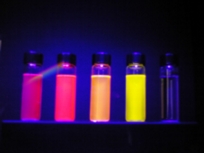
Ethanol -purple; Dichloromethane -bright pink; Toluene -orange; Cyclohexane -yellow ; Acetone + Water -blue.
Nile red is an organic compound that is strongly fluorescent and can be dissolved in a number of different solvents to produce solutions of differing colours. The nile red molecule behaves differently in differing environments (solvents) and this behaviour is expressed through the emission of light in discrete parts of the visible light spectrum. For example, if one dissolves nile red in water, the solution takes on a strong blue colour, where as in toluene, a solvent commonly found in paint strippers, the solution takes on a yellow colour.
This ability of nile red to sense its environment is what makes it such a useful biological imaging tool as it reveals information about the sample it is exposed to, through the different colours it expresses. What nile red is sensing are the differing polarities of the solvents. The higher the polarity of the solution, the bluer the fluorescent emission; the lower the polarity of the solvent the redder the fluorescent emission. The polarity of a solvent refers to the charge of its molecules. To talk of a specific polarity of a solvent is to describe what type of solid can be dissolved within it. The rule of thumb is that like dissolves like: highly polar solvents are hydrophilic (water loving) and will dissolve hydrophilic substances; where as lipophilic ("oil loving") solutions dissolve lipophilic solids. If you have ever noticed the way in which oil and water do not mix, you are observing the non-dissolving of a lipophilic substance in a hydrophilic solvent.
"This is one cool molecule" -Dr Klaus Suhling, Physicist, King's College London. Solutions kindly mixed by Klaus Suhling.